Neural Network
A multi-layer perceptron (MLP) algorithm with backpropagation.
Inputs
Data: input dataset
Preprocessor: preprocessing method(s)
Outputs
Learner: multi-layer perceptron learning algorithm
Model: trained model
The Neural Network widget uses sklearn's Multi-layer Perceptron algorithm that can learn non-linear models as well as linear.
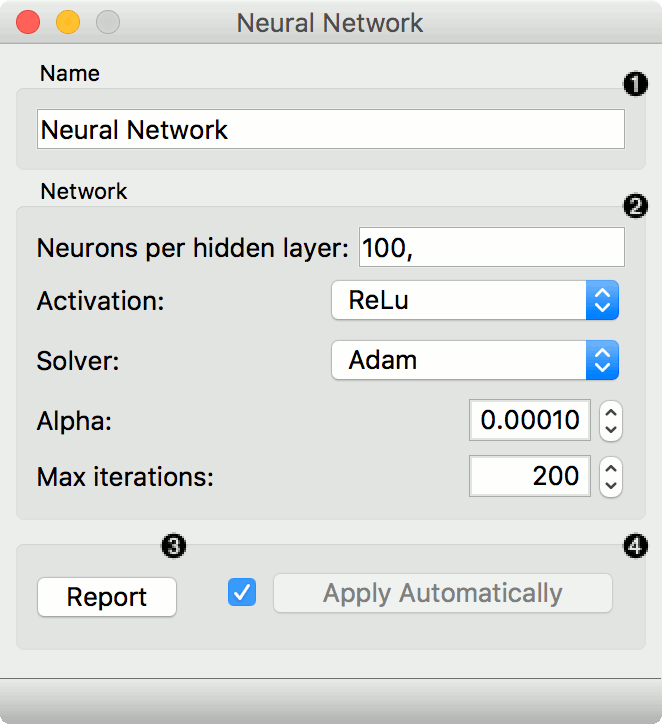
A name under which it will appear in other widgets. The default name is "Neural Network".
Set model parameters:
Neurons in hidden layers: the setting represents the number of neurons in the i-th hidden layer. E.g. a neural network with 3 layers can be defined as
2,3,2.Activation function for the hidden layer:
Identity: no-op activation, useful to implement linear bottleneck
Logistic: the logistic sigmoid function
tanh: the hyperbolic tan function
ReLu: the rectified linear unit function
Solver for weight optimization:
L-BFGS-B: an optimizer in the family of quasi-Newton methods
SGD: stochastic gradient descent
Adam: stochastic gradient-based optimizer
Regularization: L2 penalty (regularization term) parameter
Maximal number of iterations: highest number of iterations
Replicable training: if ticked, training results can be reproduced.
Other parameters are set to sklearn's defaults.
When Apply Automatically is ticked, the widget will communicate changes automatically. Alternatively, click Apply.
Preprocessing
Neural Network uses default preprocessing when no other preprocessors are given. It executes them in the following order:
removes instances with unknown target values
continuizes categorical variables (with one-hot-encoding)
removes empty columns
imputes missing values with mean values
normalizes the data by centering to mean and scaling to standard deviation of 1
To remove default preprocessing, connect an empty Preprocess widget to the learner.
Example
The example is a classification task on the iris dataset from the File widget. We compare the results of Neural Network with the Logistic Regression in the Test and Score widget.
